
Swimming Anatomy: Efficient Muscle Usage by Stroke
Freestyle Technique • Swimming Biomechanics • Efficient Propulsion
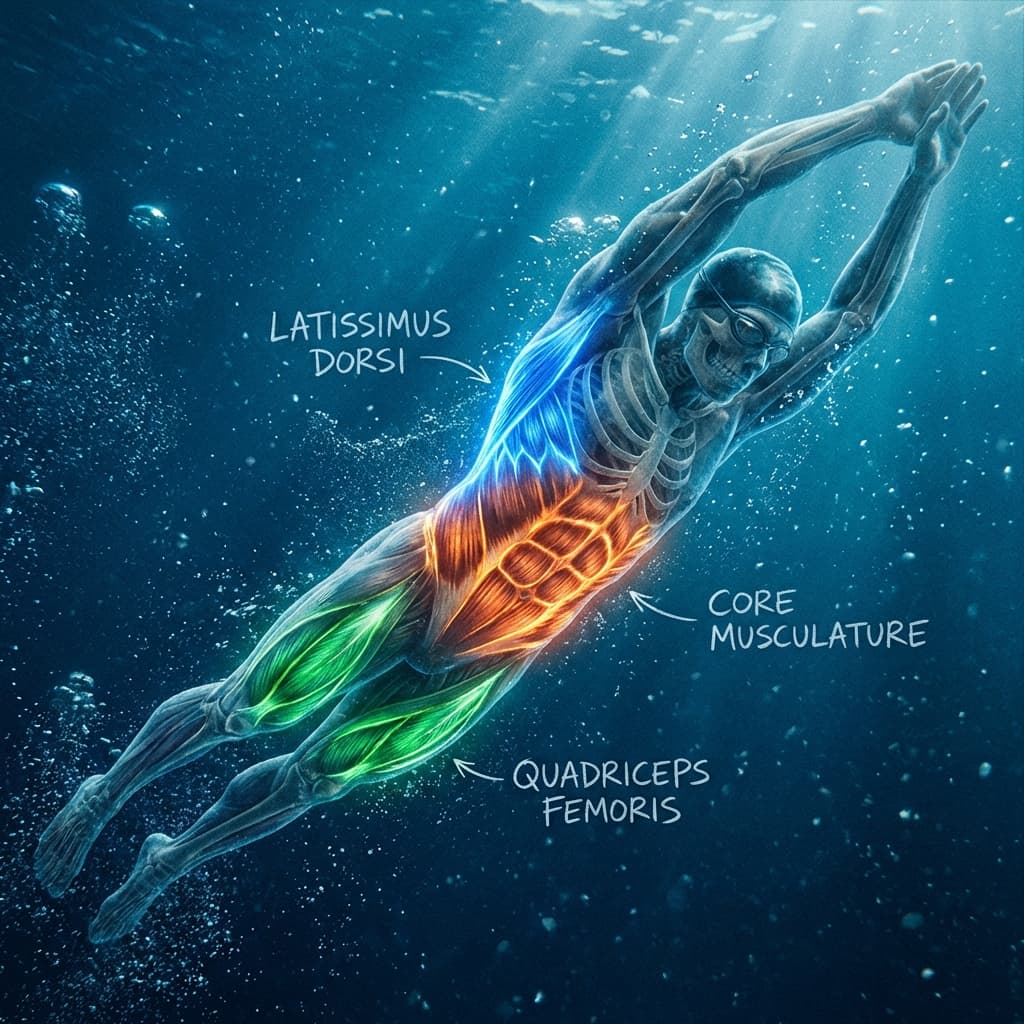
Swimming is counter-intuitive. In a gym, we move weights relative to our bodies; in the water, we must anchor our hand in a fluid medium and pull our entire body mass past it. This requires a transition from "pulling" to **"anchoring."** The cornerstone of this transition is **Early Vertical Forearm (EVF)**?a biomechanical strategy that maximizes propulsive surface area while optimizing the torque produced by the shoulder. This is a technical dissection of human movement through water.
1. Torque and the Moment Arm: The Physics of the Shoulder
The shoulder joint functions as a fulcrum. In physics, torque (τ) is calculated as the product of Force (F) and the Moment Arm (r):
τ = r × FIn swimming, the "Force" is generated by your muscles, and the "Moment Arm" is the distance from your shoulder to the center of pressure on your palm/forearm. A straight-arm pull (dropped elbow) creates a very long moment arm, which places massive stress on the rotator cuff and prevents you from accessing the powerful muscles of the back.
Catch Dynamic Analysis (Virtual Example)
Comparing the propulsive efficiency of the Dropped Elbow versus EVF.
| Variable | Dropped Elbow (Straight) | High Elbow (EVF) | Efficiency Gain |
|---|---|---|---|
| Surface Area | Palm (~15% of arm) | Palm + Forearm (~45%) | + 300% |
| Thrust Vector | Downward (Lift) | Backward (Propulsion) | Dominant |
| Joint Longevity | High Impingement Risk | Optimal Alignment | Critical |
The matrix proves that EVF is not just a stylistic choice; it is a mathematical necessity for maximizing propulsive surface area while protecting the acromion joint.
2. The Early Vertical Forearm (EVF): Maximizing Surface Area
The goal of the catch is to make the forearm perpendicular to the bottom of the pool as quickly as possible. When the forearm is vertical, it acts as a paddle. If the elbow is "dropped," the arm is diagonal, meaning much of the water is pushed *downward* rather than *backward*. Pushing water down lifts your head up (increasing drag), but it doesn't move you forward.
3. Muscle Recruitment Pathways: Transitioning to the Lats
Novice swimmers often suffer from "Shoulder Burn" because they attempt to pull water using the relatively small Deltoid muscles. High-performance swimming utilizes the **Latissimus Dorsi** and **Pectoralis Major**.
By maintaining a high elbow during the catch, you put the shoulder into a position of internal rotation that "links" the arm to the torso. This allows the power for the stroke to come from the core and back, turning your arms into rigid lever arms that transfer body-rotation torque into forward speed.
4. Hydrodynamics of the Catch: Anchoring in a Fluid Medium
Think of the water as a ladder. You don't pull the rung down; you pull yourself up. The moment your hand enters the water, it should become a "fixed point." If your hand slips through the water (bubbles trailing, high-speed movement), you have lost your anchor. A slow, methodical, "heavy" catch is far more effective than a fast, splashing one.
5. Example: Ian Thorpe's "Propeller" Kick & EVF Integration
Analysis of how total-body torque increases propulsive yield.
Case Analysis: The Thorpean Torque
Biomechanical studies of Ian Thorpe (The Thorpedo) revealed that his massive feet created a counter-torque that allowed his upper body to hold an unusually high elbow position even under extreme Fatigue.
Thorpe didn't just pull with his arms; he used his **6-beat kick** to rotate his hips which, through the connective tissue (fascia) of the core, amplified the force applied at the forearm. By integrating the kick into the stroke timing, he maximized the "moment" on the water, enabling him to move more water per stroke than any competitor of his era. This resulted in the lowest "Stroke Count" in elite 400m freestyle history.
6. Injury Prevention: The Impingement Zone
"Swimmer's Shoulder" is often the result of the **Crossover**. When the hand enters the water and crosses the centerline of the body, the supraspinatus tendon is pinched. To prevent this, swimmers must maintain a "Wide Entry"?shoulder-width apart. This keeps the subacromial space open and allows for a safer, more powerful EVF initiation.
Stroke Safety & Power Benchmarks (Virtual Example)
Diagnostic indicators for stroke health and propulsive efficiency.
| Indicator | Red Flag (At Risk) | Green Flag (Optimal) | Reasoning |
|---|---|---|---|
| Entry Point | Centerline Cross | Shoulder Width | Subacromial Space Clearance |
| Wrist Position | Bent Backward | Flat / Flexed | Laminar Flow Maintenance |
| Elbow Path | Dropping Below Hand | Above Hand (EVF) | Maximum Propulsive Surface |
The "Green Flag" path ensures that the swimmer is utilizing their skeleton to bear the load of the water, rather than solely relying on the soft tissues of the shoulder joint.
7. Common Pitfalls in Freestyle Stroke Biomechanics
- The "Bubbles" Catch: Trapping air under the hand during entry. Air is $1/800$th the density of water; your hand cannot anchor on air. Enter fingertips first to "clean" the hand before the pull.
- Short-Changing the Finish: Pulling the hand out of the water too early. You lose the final $20\%$ of propulsive torque which is generated by the triceps at the back of the stroke.
- The "Flat" Swim: Failing to rotate the hips. A flat swimmer must use only their arms, whereas a rotating swimmer uses their entire core momentum to drive the hand backward.
- Over-gliding: Letting the front hand "sit" too long without starting the catch. This causes you to lose momentum between strokes, forcing you to "re-accelerate" with every pull.
- Clenched Fingers: Squeezing the fingers together tightly. A slightly "relaxed" hand (small gaps) actually creates a larger effective surface area due to boundary layer fluid dynamics.
8. FAQ
Why does EVF feel so hard on my lats?
Because you are finally using them! Most swimmers are "shoulder-dominant." The fatigue in your lats is a sign that you are moving more water and generating more torque.
Should I use paddles to learn EVF?
In moderation. Paddles exaggerate the feeling of the catch, but if your elbow still drops, you will just increase the injury risk to your shoulder. Use tech-paddles that fall off if your elbow drops.
How do I fix a dropped elbow?
Focus on the "Fist Drill." Swimming with a closed fist removes the palm as a surface, forcing your brain to use the forearm as the primary paddle. This naturally encourages an EVF position.
*All HobbyTier content is based on general performance data and should not be taken as medical advice.
Always consult with a professional before starting new training protocols.
Document info
- Author: HobbyTier Editorial Team
- Updated: 2026-02-09
- Change summary:
- Refined biomechanical analysis of each stroke mechanism.
- Updated muscle activation patterns based on modern kinesiology.