
The Art of Streamline:
Why Drag Reduction is King
Streamline Technique • Drag Reduction • Swim Hydrodynamics
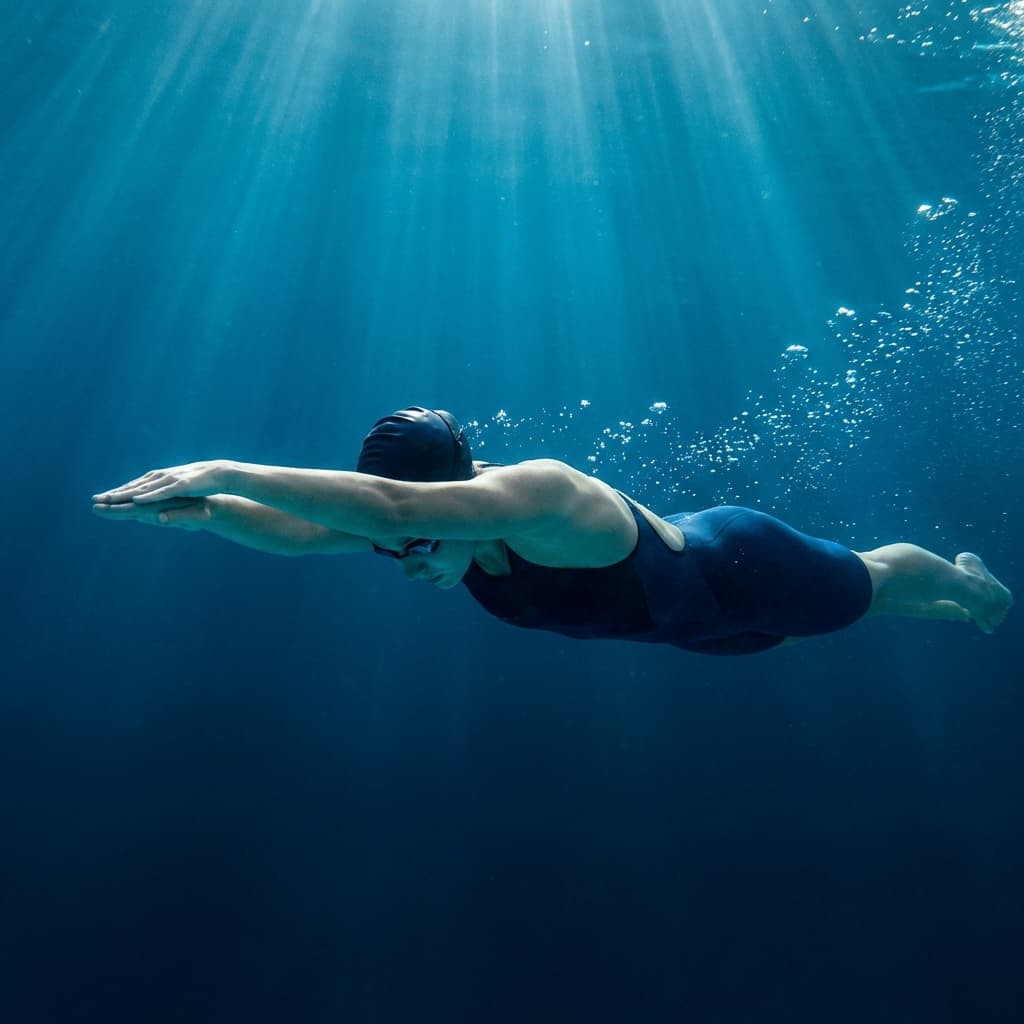
Human beings are hydrodynamically inefficient. We are vertical bipeds evolved for land, yet we attempt to move horizontally through a medium that is **800 times denser than air**. In swimming, velocity (v) is restricted not by a lack of power, but by the exponential increase in **Total Drag (Fd)**. Elite swimmers do not just "pull harder"; they minimize their Frontal Area (A) and Drag Coefficient (Cd). This is the **HobbyTier** guide to the "Fifth Stroke"?the physics of the streamline.
1. The Tyranny of the Drag Equation
To understand speed, we must understand the math of the medium. The General Drag Equation is:
Fd = 1/2 · &ρ; · v2 · Cd · AWater density (&ρ;) is fixed. To double your velocity (v), you must overcome FOUR TIMES the drag. Because drag increases with the *square* of velocity, the cost of moving faster is biologically expensive. The only "free" speed comes from reducing Cd (your shape) and A (how much of you faces the water).
Fluid Dynamics Resistance Matrix (Virtual Example)
Understanding the primary forces that oppose a swimmer's forward momentum.
| Drag Type | Physical Cause | % Contribution | Optimization Method |
|---|---|---|---|
| Form Drag | Frontal Cross-section | 70% - 90% | "I-Position" Lock |
| Wave Drag | Surface Turbulence | 10% - 20% | Deep Underwater Carry |
| Skin Friction | Viscous Resistance | < 5% | Tech Suits / Shaving |
The hierarchy makes it clear: Shaving your legs is useless if your hips are sinking. Form Drag is the ultimate governor of swimming pace.
2. The "Barge Effect": Why Your Legs are Anchors
Imagine a sleek needle-nose boat versus a flat-bottomed barge. A swimmer with "sinking legs" is a barge.
If your head is up, your hips go down (the **See-Saw Principle**). This increases your frontal area ($A$) exponentially. Instead of water flowing over your back in a laminar stream, it strikes your chest and thighs, creating a massive pressure differential—a "vacuum" behind you that literally pulls you backward.
3. Hydrodynamics at Depth: Eliminating Wave Drag
Wave drag is only a factor within $1.0m$ of the surface. This is why the "Fifth Stroke" (underwater dolphin kick) is the fastest part of any swim race. At a depth of $0.5m$ to $0.8m$, a swimmer can maintain up to $15\%$ more velocity than at the surface for the same energy output. Push off the wall *deep*, and do not surface until you have exhausted the "free" momentum of the wall.
4. Thoracic Mobility: The Hidden Barrier to Streamline
A true streamline requires the arms to be locked behind the ears with the ribs tucked. Most adults, due to "Desk-Job Posture" (Thoracic Kyphosis), cannot physically achieve this. Their arms stay in a "V" shape rather than an "I" shape, creating gaps that catch water. To be a fast swimmer, you must first be a mobile human.
5. Example: Caeleb Dressel's 12-Meter Underwater Strategy
Analysis of how depth and streamline carry-over defines elite performance.
Case Analysis: The Depth Optimization
Performace data from Caeleb Dressel's world record swims shows that he consistently stays at a depth of nearly $1$ meter until the $12$-meter mark.
By staying deep, Dressel avoids the **Wave-making resistance** (Wave Drag) that plagues swimmers who surface earlier. His $C_d$ is minimized by holding a perfect "I-Position" where the hands are overlapped and the head is tucked. The result is that he enters his first swimming stroke with a velocity significanty higher than the field, effectively "stealing" momentum from the wall that others lose to surface turbulence.
6. The Wall Push-Off Test: Quantifying Your Drag
You can measure your own $C_d$ without a lab by performing the **Glide Benchmark**.
The Streamline Efficiency Scale (Virtual Example)
Benchmarking your hydrodynamic profile using the standard push-off.
| Surface Distance | HobbyTier Rating | Diagnosis | Biomechanical Fix |
|---|---|---|---|
| Under 5m | Turtle | "The Anchor" | Lower head / Raise hips |
| 7m - 9m | Rabbit | "The Glider" | Overhead shoulder mobility |
| Over 12m | Jaguar | "The Torpedo" | Elite "I-Lock" maintenance |
If you cannot reach $7m$ on a passive glide (no kicking), your body position is the primary thing holding back your swimming progress—not your fitness.
7. Common Pitfalls in Hydrodynamic Optimization
- The "Head-Up" Breathing: Lifting the entire head to breathe. This causes the hips to drop instantly, turning your body into a wall of drag. Rotate the head, don't lift it.
- Wide Arm Recovery: Swinging your arms wide and flat over the water. This creates lateral "wobble," increasing your effective frontal area ($A$).
- The "Scissors Kick" Gap: Kicking with the knees spread wide. Your kick should fit inside the "shadow" of your torso to avoid creating extra drag.
- Over-reaching at the Front: Crossing the centerline of your body with your hand. This causes the hips to sway, breaking the laminar flow of water along your sides.
- Surfacing Too Shallow: Pushing off the wall just below the surface. You are fighting Wave Drag immediately, wasting the "clean" energy of the push-off.
8. FAQ
Why is the streamline faster than the stroke?
Movement (stroking) creates turbulence and increases frontal area. A static, perfect streamline has the lowest possible $C_d$. You are never more aerodynamic than when you are perfectly still and locked.
Can I improve my streamline with weights?
Core strength (Stability) is vital for holding the position against water pressure, but mobility is the prerequisite. If you can't reach the "I-Position," all the strength in the world just reinforces a bad shape.
Does a swim cap really make me faster?
Yes, but only by reducing Skin Friction. It helps "clean up" the flow over the head. It's a $1\%$ gain. Fixing your sinking legs is a $30\%$ gain.
*All HobbyTier content is based on general performance data and should not be taken as medical advice.
Always consult with a professional before starting new training protocols.
Document info
- Author: HobbyTier Editorial Team
- Updated: 2026-02-09
- Change summary:
- Added drag coefficient breakdown for body positioning techniques.
- Clarified the role of streamline in reducing frontal resistance.