
Hydrodynamics: Why Technique Trumps Power in Swimming
Swimming Hydrodynamics • Drag & Vortices • Efficiency
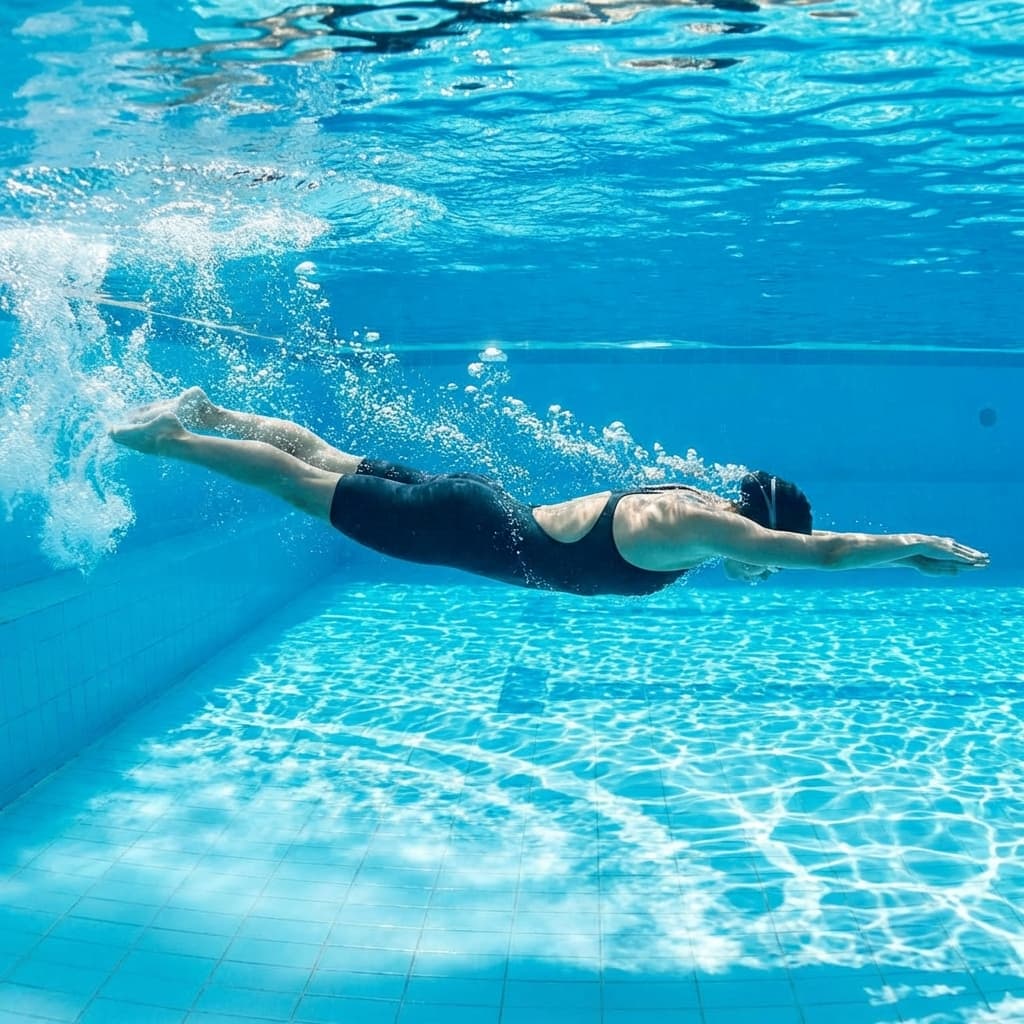
Water is a brutal medium. It is nearly 800 times denser than air and 55 times more viscous. In this environment, a swimmer's greatest adversary is not their rival—it is **Drag**. To double your speed, you must overcome eight times the resistance. This mathematical reality is why the world's fastest swimmers focus on reducing their **Drag Coefficient (Cd)** rather than maximizing muscle force. High-level swimming is the art of becoming an aquatic needle.
1. Total Resistance: The Sum of Drag Components
Hydrodynamic resistance is not a monolithic force. It is the summation of three distinct physical phenomena. To improve efficiency, a swimmer must address each according to the **Drag Equation**: D = 1/2 · ρ · v² · Cd · A.
While density (ρ) is fixed by the pool environment, the swimmer has total control over velocity (v), surface area (A), and the shape factor (Cd). Because velocity is squared, any technical flaw in A or Cd exponentially increases the energy required to maintain speed.
The Three Resistances Matrix (Virtual Example)
Breaking down the primary hydrodynamic obstacles and their technical solutions.
| Drag Type | Physical Cause | Technical Solution | % Total Impact |
|---|---|---|---|
| Pressure (Form) Drag | Body Shape Interference | Streamline Alignment | 50% - 60% |
| Wave Drag | Surface Interaction | Underwater Pushes | 20% - 30% |
| Viscous (Skin) Drag | Molecular Rubbing | Suits / Shaving | 10% - 15% |
The matrix demonstrates that **Form Drag** is the primary culprit for slow times. A shaven body or $500 suit means nothing if your hips are sinking, creating a massive surface area (A) for the water to hit.
2. The Reynolds Number and Boundary Layer
The **Reynolds Number (Re)** is a dimensionless value that tells us if water flow is **Laminar** (smooth) or **Turbulent** (chaotic). Swimmers operate in a high Re environment, meaning the flow is almost always turbulent.
The goal of technical suits and correct "catch" positions is to manipulate the **Boundary Layer**?the thin layer of water sticking to your skin. If this layer separates from the body too early, it creates a massive "wake" (low-pressure zone) behind you that literally pulls you backward. Maintaining attachment of the boundary layer as long as possible is the key to elite "slipping."
3. Wave Drag and the Froude Number Limitation
When you swim at the surface, you create waves. Creating waves requires work. As you approach a certain speed (relative to your body length), you eventually get "trapped" within your own wave system. This is related to the **Froude Number**.
This is the reason the 15-meter underwater rule exists in Olympic categories. Swimmers are significantly faster underwater because they avoid wave drag entirely, interacting only with the (less taxing) form and viscous drag.
4. Vortex Mechanics: Finding "Stiff" Water
Propulsion is no longer thought of as just "pushing water back." Modern **Computational Fluid Dynamics (CFD)** analysis shows that elite swimmers generate **Vortices** (spinning rings of water). By creating a vortex with the palm and forearm, the swimmer creates a "stiff" patch of water to pull against. It is like finding a ledge in the void; if you "slip" through the water, you are failing to generate the necessary vortex-driven pressure gradient.
5. Example: Michael Phelps and the Fifth Stroke Optimization
Analysis of how a master of hydrodynamics utilizes basic physics to dominate the field.
Case Analysis: Avoiding the Surface Barrier
Michael Phelps and coach Bob Bowman revolutionized the "underwater dolphin kick," now known as the "Fifth Stroke." While others would surface early to breathe and use their arm strength, Phelps would stay deep (0.5m-1m) after every turn.
By staying underwater, Phelps experienced near-zero **Wave Drag**. While his competitors struggled against the surface surface barrier, Phelps used his hyper-mobile ankles and "pencil" streamline to maintain a velocity 15-20% higher than his surface sprint. He wasn't stronger than the others; he was simply interacting with a different set of physical laws.
6. Cd Optimization: Streamlining as a Skill
Reducing your drag coefficient requires constant feedback. In the HobbyTier system, we categorize streamlining into three phases:
The Aquatic Efficiency Roadmap (Virtual Example)
Benchmarks for technical mastery of the aquatic environment.
| Technical Phase | Focus Metric | CNS Cue | Efficiency Gain |
|---|---|---|---|
| Tier 7: Basic Float | Horizontal Buoyancy | "Hips to the Surface" | +40% (Drag reduction) |
| Tier 3: Streamline Elite | Cd Minimization | "Squeeze the Ears" | +15% (Speed maintenance) |
| Tier 1: Vortex Master | Added Mass Pull | "Hook the Vortex" | +10% (Propulsive efficiency) |
Mastering the "basics" of buoyancy provides four times the benefit of mastering "advanced" vortex mechanics. Structure always precedes propulsion.
7. Common Pitfalls in Hydrodynamic Adaptation
- The "Head-Up" Error: Lifting the head to look forward. This causes the lower body to act as an anchor, increasing form drag by 30% instantly.
- Short-Axis Wiggle: Allowing the hips to snake left and right during freestyle. This breaks the **Laminar Flow** of the boundary layer, creating massive turbulence.
- Over-Pulling: Applying maximal force at the beginning of the stroke before the "Catch" is set. This creates bubbles (air entrainment) which have low density and zero "stiffness" to pull against.
- Surface Slapping: Entering the water with a flat hand. This creates a "Splash" which is essentially wasted kinetic energy being converted into sound and heat rather than forward motion.
- Ignoring Ankle Flexibility: Stiff ankles act as "brakes" in the water. Without at least 15° of plantar flexion past neutral, the kick creates more drag than propulsion.
8. FAQ
Does muscle mass help in swimming?
Only up to the point where it increases power without drastically increasing frontal surface area (A) or reducing flexibility. Excessive bulk often increases drag more than it adds propulsive force.
Why are technical suits so expensive?
They use ultrasonic welding and hydrophobic coatings to compress the body into a more "solid" hydrodynamic shape and reduce viscous drag by manipulating the boundary layer.
Is the S-Curve pull still recommended?
No. Modern CFD analysis has proven the "Early Vertical Forearm" (EVF) to be superior for creating the pressure gradients and vortices needed for modern elite speeds.
*All HobbyTier content is based on general performance data and should not be taken as medical advice.
Always consult with a professional before starting new training protocols.
Document info
- Author: HobbyTier Editorial Team
- Updated: 2026-02-09
- Change summary:
- Expanded fluid mechanics principles specific to aquatic propulsion.
- Integrated wave drag and form drag mitigation strategies.