
Strength vs. Hypertrophy: Training for Function over Form
Strength vs Hypertrophy • Muscle Growth • Neuromuscular Adaptation
Why can a 65kg Olympic lifter clean & jerk 180kg, while a 100kg bodybuilder might struggle to deadlift 220kg— In the biological realm of strength, the answer lies in the distinction between **Neural Software** (the brain's command system) and **Structural Hardware** (the muscle fibers themselves). This article explores the physiological divergence of **Strength** and **Hypertrophy** through **HobbyTier's** meta-analytical standards.
1. Software vs. Hardware: The Neuro-Morphological Divide
"Big muscles generally equal strong muscles, but not always." This phenomenon is explained by the **Force Equation**: Force ($F$) = Mass ($m$) x Acceleration ($a$). While hypertrophy increases the "Mass" of the contractile tissues, strength is often a result of maximizing "Acceleration" through neural drive.
Strength is a neurological skill. It requires the brain to synchronize the firing rate of thousands of motor units simultaneously. Hypertrophy is a morphological adaptation—an increase in the physical cross-sectional area (CSA) of the muscle. You can upgrade the engine (Hypertrophy) or you can tune the computer controlling it (Strength).
Neuromuscular vs. Structural Adaptation (Virtual Example)
Comparing the primary drivers and biological endpoints of the two principal training adaptations.
| Variable | Strength (Force) | Hypertrophy (Size) | Primary Limit |
|---|---|---|---|
| Neural Drive | Maximum (1-5 Reps) | Moderate (6-12 Reps) | CNS Fatigue |
| Sarcomere Accretion | In Parallel | Parallel & Series | Anabolic Ceiling |
| Metabolic Stress | Low | Maximum | Substrate Depletion |
The matrix clarifies why powerlifters and bodybuilders often look and perform differently despite both lifting weights. One focuses on neural efficiency; the other on metabolic volume.
2. Henneman's Size Principle: The Recruitment Hierarchy
Your nervous system is inherently lazy. It follows **Henneman's Size Principle**, which states that the smallest, weakest motor units (Type I fibers) are recruited first. Only when the load is high enough (typically $80\%+$ of 1RM) or the muscle is nearing total fatigue will the brain call upon the massive, powerful Type IIx fibers.
Strength training (lifting heavy) forces the brain to "skip the queue," developing the neural pathways to recruit those high-threshold motor units early and often. Hypertrophy training (lifting for volume) ensures those fibers are recruited and then *kept under tension* long enough to trigger metabolic growth signals.
3. Rate Coding: Mastering the Neural Software
Beyond recruitment is **Rate Coding**. This is the frequency of the electrical pulses the brain sends to the muscle. In elite strength athletes, the rate of these signals is significantly higher, causing the muscle to enter a state of "fused tetanus" where force is constant and maximal. Improving your rate coding is like upgrading your internet from 4G to Fiber—the commands reach the muscle faster and with more clarity.
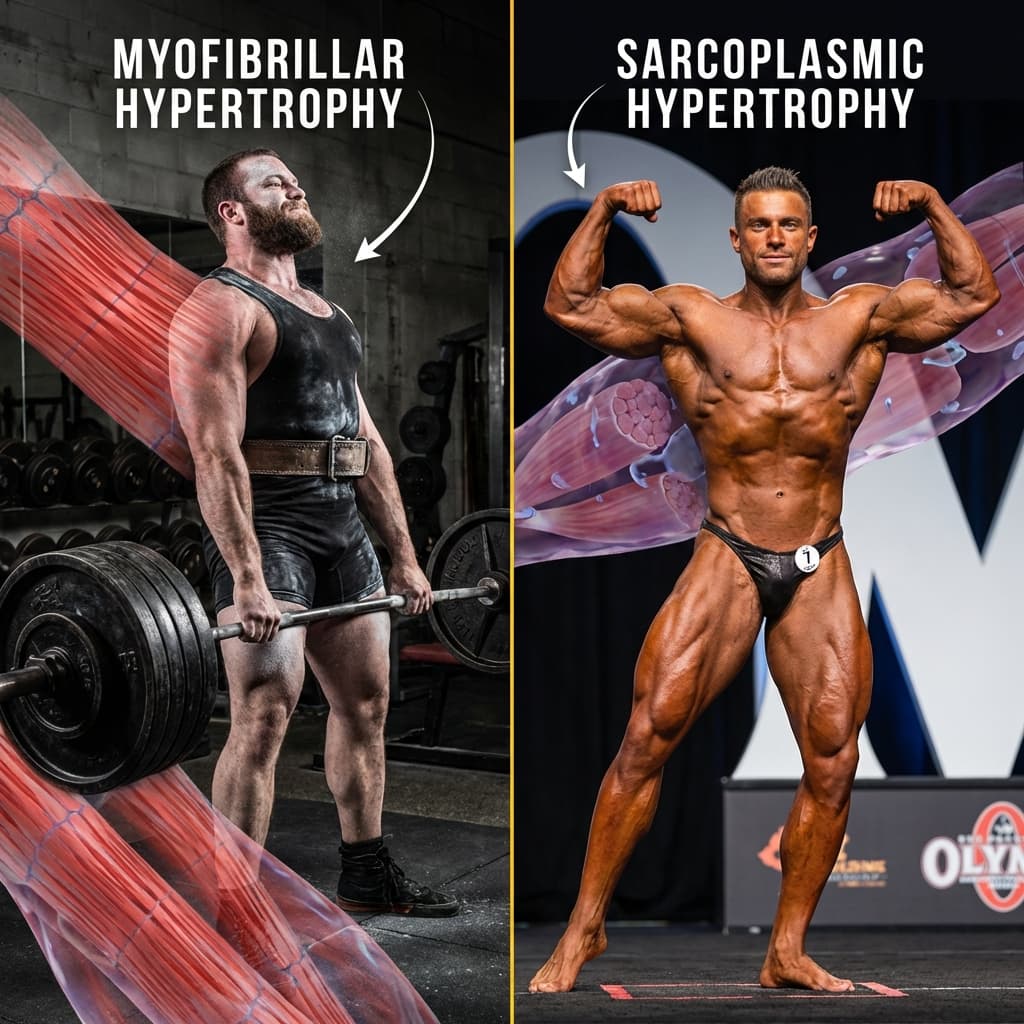
4. Myofibrillar vs. Sarcoplasmic Hypertrophy
"Big and soft" vs. "Small and dense." This reflects the two types of hypertrophy:
- Myofibrillar Hypertrophy: An increase in the actual contractile proteins (Actin/Myosin). This increases the actual force production capability of the fiber.
- Sarcoplasmic Hypertrophy: An increase in the non-contractile fluid (glycogen, water, sarcoplasm) within the muscle cell. This increases size and volume but does not significantly contribute to 1RM strength.
5. Example: The Westside Barbell "Software" Hack
Analysis of how neurological training creates world-record force production with moderate mass.
Case Analysis: Practicing Force as a Skill
The "Dynamic Effort" method popularized by Westside Barbell involves lifting $50-60\%$ of a max as fast as humanly possible. To an observer, it looks "light." To the brain, it is a maximal recruitment task.
By aiming for maximal velocity, the lifter is forced to fire their motor units at an elite frequency (High Rate Coding). This "software upgrade" allowed lifters to move world-record totals without needing the excessive sarcoplasmic hypertrophy of an 8-12 rep bodybuilder. They spent their sessions practicing the *skill* of firing, not just the *labor* of moving.
6. Daily Undulating Periodization (DUP): Maximizing the Total
If you want to be both big and strong, you must target both adaptations. **DUP** involves switching the focus within a single week.
The DUP Powerbuilding Split (Virtual Example)
Targeting the software and hardware of the musculoskeletal system in a single microcycle.
| Day Focus | Target Intensity | Biological Target | Adaptive Reward |
|---|---|---|---|
| Strength Day | 85% - 95% 1RM | CNS / Recruitment | Maximum Force Output |
| Hypertrophy Day | 70% - 80% 1RM | mTOR / Ribosomal | Cross-Sectional Area |
| Power Day | 50% - 60% 1RM | RFD / Rate Coding | Explosivity / Speed |
By rotating these focuses, you ensure that the brain never forgets how to fire (Software) while the muscles are constantly given the volume needed to grow (Hardware).
7. Common Pitfalls in Balanced Strength-Hypertrophy Programming
- Short Rests on Strength Days: Rushing your squats to get "a better pump." Strength requires full ATP-PC recovery (3-5 minutes) to express maximal neural output.
- Ignoring the Eccentric: Dropping weights on hypertrophy days. The lowering phase (eccentric) is the primary trigger for the micro-trauma and metabolic stress needed for growth.
- "Bodybuilding" the Big Lifts: Trying to isolate muscles during a 1RM deadlift. The Big Three are systemic skills; isolation is for the accessories.
- Chronic CNS Burnout: Attempting to train for "Strength" (90%+) every single day. The brain takes 4x longer to recover than the muscle fibers.
- Metabolic Neglect: Lifting heavy for 3 reps then eating like a bird. Hypertrophy requires a caloric surplus to synthesize new proteins; strength alone does not.
8. FAQ
Do I have to choose one or the other—
No. Most athletes benefit from a "base" of hypertrophy to increase their potential ceiling for strength. You cannot fire a 100-watt bulb through a 10-watt wire.
Why do bodybuilders look bigger than powerlifters?
Sarcoplasmic hypertrophy. Bodybuilders target the glycogen and fluid volume of the cell, which creates a "fuller" appearance compared to the "dense" look of a pure powerlifter.
How long does it take to see neural strength gains?
Neural gains happen almost instantly (2-4 weeks). This is why beginners see their lifts jump rapidly before any physical muscle growth is visible.
*All HobbyTier content is based on general performance data and should not be taken as medical advice.
Always consult with a professional before starting new training protocols.
Document info
- Author: HobbyTier Editorial Team
- Updated: 2026-02-09
- Change summary:
- Clarified neural versus sarcoplasmic adaptations for long-term strength development.
- Outlined rep scheme optimization for myofibrillar hypertrophy.