
The Paradox of Cold Therapy: Recovery vs. Hypertrophy
Cold Water Immersion • Recovery Timing • Strength Adaptation
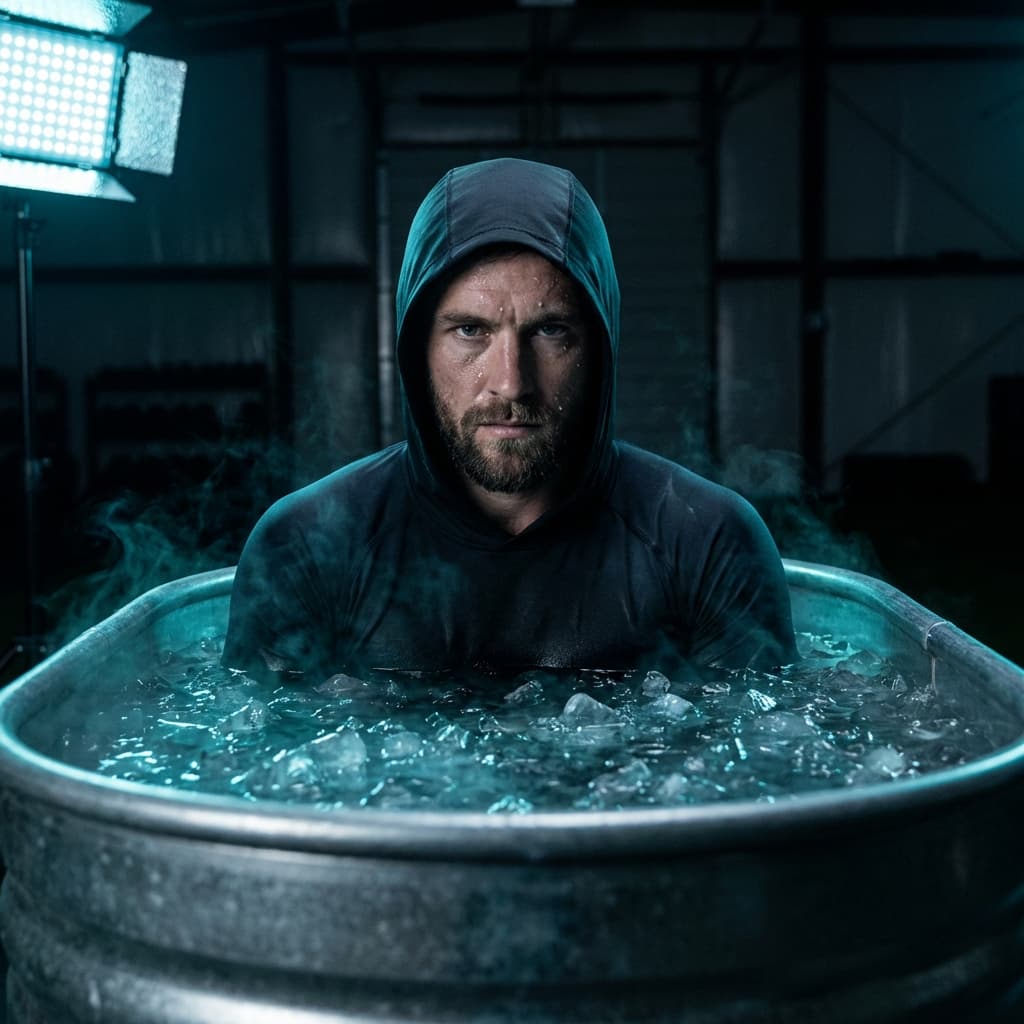
You have seen it in every sports documentary: elite athletes submerged in ice-filled tubs immediately following competition. This "Cold Water Immersion" (CWI) is marketed as the ultimate recovery hack. However, recent peer-reviewed literature suggests a startling paradox: the very tool used to speed up recovery may be actively sabotaging your muscular adaptations. This article dissects the molecular mechanics of the ice bath through **HobbyTier's** physiological standards.
1. Molecular Mechanics of Cold: Suppression of mTOR
At the heart of muscle growth is the **mTORC1** pathway (mammalian Target of Rapamycin Complex 1). This is the master switch that flips your body from a catabolic (breaking down) state to an anabolic (building up) state.
Data from Roberts et al. (2015) and others have shown that immediate cold exposure post-resistance training causes a significant downregulation of p70S6K phosphorylation—a key marker of mTOR activity. Essentially, deep cold "stuns" the cellular machinery responsible for Muscle Protein Synthesis (MPS), delaying the growth signal for up to 48 hours.
Acute vs. Chronic Adaptation Matrix (Virtual Example)
Comparing how common recovery tools affect different biological endpoints.
| Modality | Acute Pain Relief | Hypertrophy Impact | Neural Recovery |
|---|---|---|---|
| Ice Bath (CWI) | Maximum (Excellent) | Inhibitory (Bad) | High (Sympathetic) |
| Active Recovery | Moderate | Promotive (Good) | Moderate (Parasympathetic) |
| Sauna (Heat) | Low | Neutral/Positive | Moderate |
The matrix clarifies that while CWI is the "gold standard" for pain, it is the "antagonist" of growth. Choosing your modality requires a clear understanding of your primary training goal: Are you trying to grow, or just survive until tomorrow's match?
2. The Inflammatory Trigger: Acute vs. Chronic
The fitness world has been conditioned to view "inflammation" as a villain. This is a scientific error. **Acute inflammation** post-exercise is the precise signal that muscle fibers use to communicate that they need to be rebuilt stronger.
By using cold therapy to blunt this inflammation, you are essentially "muffling" the call for help. Without the inflammatory cytokine cascade, satellite cells (the muscle's stem cells) are not adequately recruited to the site of damage, limiting the increase in myonuclear density.
3. Strategic Application: Performance vs. Hypertrophy
Does this mean ice baths have no place— Not at all. It is a matter of **Contextual Prioritization**.
- The Hypertrophy Phase: Focus on active recovery, sleep, and nutrition. Let the inflammation do its work.
- The Competition Phase: In a multi-day tournament (e.g., CrossFit Games), long-term growth doesn't matter. Pain management and "feeling fresh" are the priority. Here, CWI is a vital tool.
4. Example: The Rugby Recovery Cycle vs. Bodybuilding Progress
Analysis of how goal-dependent modalities determine athletic outcomes.
Case Analysis: Modality Divergence
Professional Rugby players often utilize 10-minute CWI protocols (10-12°C) between matches. Their goal is to maintain sprint speed and tackle force during a grueling season. Conversely, a bodybuilder doing the same would find their muscle cross-sectional area (CSA) plateaus.
A 2019 meta-analysis showed that while strength increases were mostly preserved, the **size** of type II fibers was significantly blunted in the "cold" group. For the Rugby player, this is an acceptable loss. For the bodybuilder, it is a catastrophic failure of strategy.
5. Non-Suppressive Alternatives for Growth-Oriented Athletes
If you want to recover without killing the mTOR signal, consider these "anabolic-friendly" tools:
Anabolic Recovery Alternatives (Virtual Example)
Methods to reduce perceived fatigue without blunting protein synthesis pathways.
| Modality | Mechanism | Best Time | mTOR Effect |
|---|---|---|---|
| Active Recovery (LISS) | Lymphatic Clearance | Immediately Post | Neutral |
| Pneumatic Compression | Pressure / Blood Flow | Post-Shower | Neutral/Positive |
| Contrast Water Therapy | Vasodilation Cycling | Next Day | Minimized Negative |
The goal is to move fluid and clear metabolic waste without dropping the tissue temperature to the point of signal inhibition.
6. Common Pitfalls in Recovery Strategy Implementation
- Icing "Just Because": Using cold therapy as a habit rather than a tool for a specific performance need.
- Too Cold for Too Long: Submerging in water below $5^o C$ for 20+ minutes, which can cause nerve damage and extreme cortisol spikes that further inhibit growth.
- Ignoring the 4-Hour Window: If you *must* use cold therapy but still want growth, wait at least 4-6 hours post-training to allow the initial mTOR spike to occur.
- The NSAID Overlap: Combining ice baths with anti-inflammatory drugs (Ibuprofen). This "Double Blunt" creates a near-total block of the adaptive signal.
- Focusing on Tools over Basics: Chasing expensive $5,000 ice tubs while averaging only 5 hours of sleep per night. Sleep is the only recovery modality with an infinite ROI.
7. FAQ
Does cold immersion help for fat loss?
Yes, but not primarily through calorie burning. It triggers the conversion of "White Fat" to "Brown Fat," which is more metabolically active. However, this is a separate goal from muscle building.
Is a cold shower enough to kill my gains?
Unlikely. The literature typically looks at "immersion" where tissue temperature is significantly lowered. A 2-minute cold shower is a great "wake-up" but likely won't blunt systemic growth signals.
When should I use heat instead—
Heat (sauna/hot tub) is generally safer for growth as it increases blood flow without the suppressive metabolic effects. It should still be used at least 2 hours apart from lifting for optimal comfort.
*All HobbyTier content is based on general performance data and should not be taken as medical advice.
Always consult with a professional before starting new training protocols.
Document info
- Author: HobbyTier Editorial Team
- Updated: 2026-02-09
- Change summary:
- Refined analysis of cold-water immersion on muscle protein synthesis.
- Compared short-term recovery benefits versus long-term hypertrophy impacts.