
Muscle Fiber Types: Type I vs Type II (and How to Estimate Yours)
Quick Answer
Humans have two primary muscle fiber types: **Type I (Slow-Twitch)**, which excels at endurance, and **Type II (Fast-Twitch)**, which is built for power and speed. While a biopsy is the only 100% accurate measurement, an 80% 1RM repetition test is a useful field estimate for training. Remember, this is a **starting point for training optimization**, not a clinical diagnosis.
If your training doesn’t match your natural strengths and recovery capacity, progress can stall and nagging aches can often show up. Understanding your dominant muscle fibers can help you train smarter.
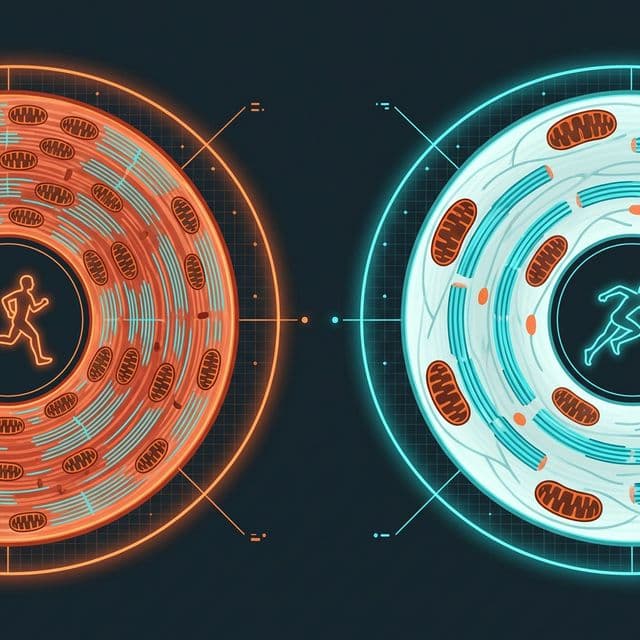
What muscle fiber types actually mean
Our muscles are made up of tiny individual fibers that contract to produce movement. Not all fibers are created equal; they vary in how fast they can twitch, how much force they produce, and how quickly they get tired.
Most people have a relatively balanced mix, but many athletes tend to lean one way or the other based on their genetics and years of training stimulus.
Type I (slow-twitch): built for endurance
Type I fibers are structural powerhouses for long-duration activities. They are dense with mitochondria and myoglobin, allowing them to use oxygen efficiently to keep you moving for hours.
- Contraction speed: Slow
- Force production: Low to moderate
- Fatigue resistance: Very high
- Ideal for: Marathons, long-distance cycling, swimming, and posture.
Type II (fast-twitch): built for power and speed
Type II fibers—often divided into IIa (mixed) and IIx (pure power)—are built for explosive bursts. They rely more on anaerobic energy systems, meaning they can produce massive force in a split second but fatigue quite rapidly.
- Contraction speed: Fast
- Force production: High to very high
- Fatigue resistance: Low
- Ideal for: Sprinting, powerlifting, vertical jumps, and boxing.
How fiber type can influence training (without overthinking it)
Knowing your bias can help you adjust your variables. For example, a fast-twitch dominant athlete may need longer rest periods between sets because their nervous system and fuel stores take longer to recover from high-intensity efforts.
Conversely, a slow-twitch dominant athlete might find they can handle much higher volumes and shorter rest periods without their performance dropping off significantly.
A practical way to estimate your bias: the ~80% 1RM rep test
This field test works because fast-twitch fibers typically experience a steeper decline in performance as repetitions increase. If you can only squeeze out a few reps at 80% of your max, you may have a higher concentration of Type II fibers.
How to run the test (step-by-step)
- Choose a compound movement like the Squat or Bench Press.
- Ensure you are fully recovered (not after a heavy training session).
- Find your true 1-Rep Max (1RM) or use a recently verified one.
- Load the bar with 80% of that 1RM.
- Perform as many reps as possible with perfect form and a consistent tempo.
How to interpret your result (ranges, not absolutes)
These are commonly used ranges in exercise physiology. Results can vary significantly based on your lifting tempo and technical efficiency.
| Reps at 80% 1RM | Likely Bias | General Interpretation |
|---|---|---|
| ~6 – 8 Reps | Fast-Twitch Leaning | High neural drive but fatigues quickly. |
| ~9 – 12 Reps | Mixed / Balanced | Standard athletic distribution. |
| ~13+ Reps | Slow-Twitch Leaning | High metabolic efficiency and recovery. |
*Caveat: Training history heavily influences these numbers. A powerlifter might have a "fast" profile simply because they rarely train in high-rep ranges.*
Training takeaways (simple adjustments)
If you tend to be more fast-twitch
- Prioritize lower rep ranges (3–6) for your main lifts.
- Take longer rest periods (3–5 minutes) to ensure full neural recovery.
- Keep an eye on total volume; you may need more deload weeks than your peers.
If you tend to be more slow-twitch
- You may respond better to higher rep ranges (10–15+).
- Shorter rest periods (60–90 seconds) can be used to maximize metabolic stress.
- Frequency can often be higher as these fibers recover relatively quickly.
If you’re mixed
You have the luxury of variety. Periodizing your training—alternating between power blocks and volume blocks—is often the most effective way to grow.
Limitations and caveats (read this)
Muscle fiber composition isn't uniform across your whole body. Your calves (soleus) are almost certainly slow-twitch dominant, while your triceps might be fast-twitch heavy.
Furthermore, fibers exhibit "plasticity." With enough specific training, Type IIa fibers can take on more endurance or power characteristics. This guide is for educational reference and is not medical advice.
FAQ
Can you change your muscle fiber type?
Yes, to an extent. While you can't usually turn a pure Type I into a pure Type IIx, the "mixed" Type IIa fibers can adapt significantly based on your training habits.
Is the 80% 1RM test accurate?
It's a useful estimate, but factors like "neural efficiency" and your specific training history can skew the results. Use it as a guide, not a final verdict.
References
- Pette, D., & Staron, R. S. (2000). Myosin isoforms, muscle fiber types, and transitions. Microscopy research and technique.
- Wilson, J. M., et al. (2012). The effects of strength, power, and hypertrophy resistance training on skeletal muscle morphology. Journal of Strength and Conditioning Research.
Document info
- Author: HobbyTier Editorial Team
- Updated: 2026-02-27
- Change summary:
- Complete native rewrite for natural English tone and SEO optimization.
- Implemented Quick Answer section and clarified performance test ranges.
- Updated disclosure and removed direct sponsorship CTA for better trust signals.